
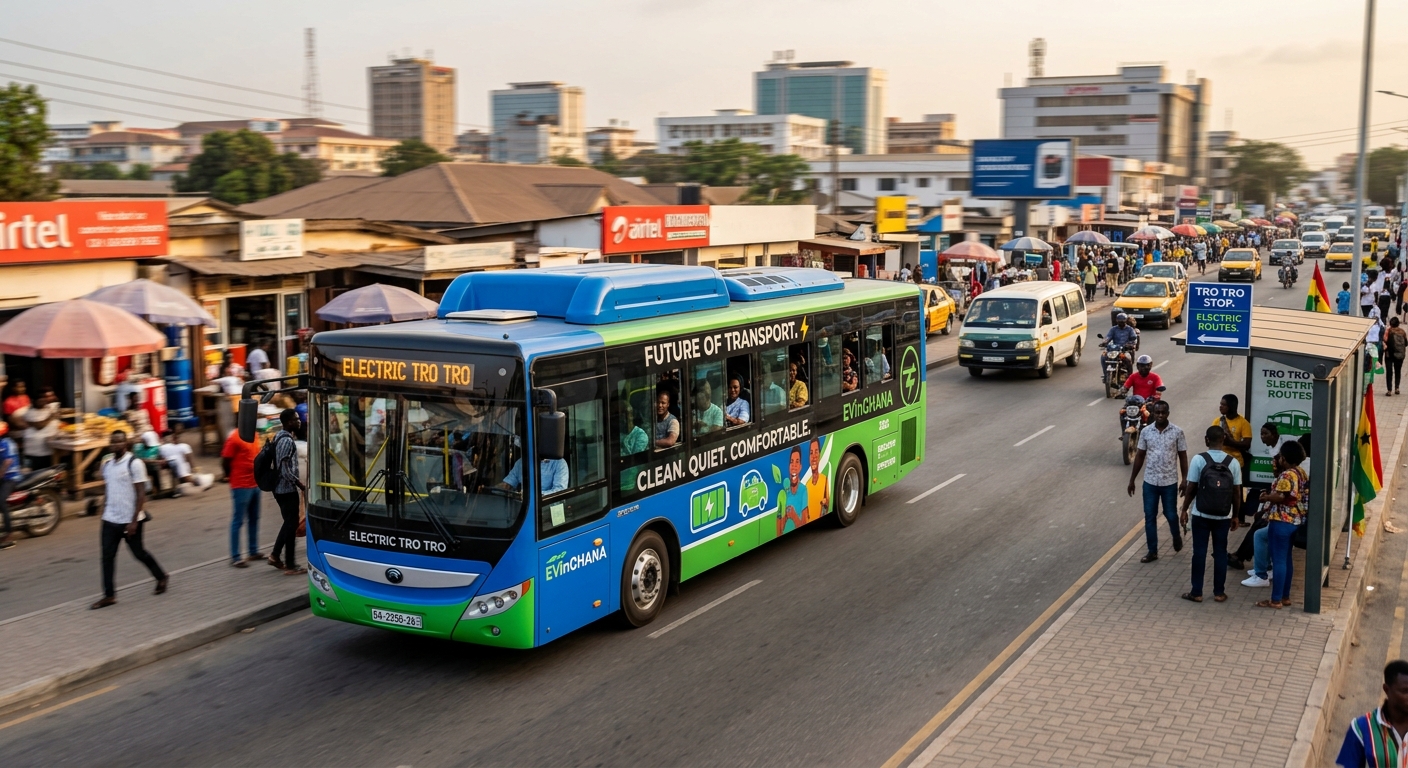
For many people in Ghana, the trotro is more than transport. It is how we get to work, school, market, church, and home again. So when a new all-electric bus service starts running in Accra and people notice the ride is smooth, the air-conditioning stays on, and there is no tailpipe smoke, it is worth paying attention.
That is the big idea behind the future some people are imagining: a trotro system that is cleaner, quieter, and more comfortable, without losing the practicality that makes trotros so important in the first place.
My switch from petrol to electric is not just a personal choice. It reflects a wider question for Ghana: can commercial transport move to electric vehicles in a way that works for our roads, our routes, and our budgets?
Why an electric trotro feels different
Anyone who has ridden in a well-run EV bus will notice the difference quickly. The vehicle starts quietly. There is less vibration. The cabin can stay cool more consistently. And because there is no exhaust at the rear, passengers and drivers are not breathing in fumes at every stop.
That matters a lot in crowded urban transport. In many parts of Accra and other cities, public transport is part of the street-level air that people inhale every day. An electric bus does not solve all air quality problems, but it can remove one major source of local pollution.
It also changes the experience for drivers and passengers. Less engine noise means less fatigue. Smoother acceleration can make stop-start city driving easier. And when a vehicle is maintained well, EV drivetrains can be simpler than petrol or diesel systems, though they still need proper servicing, trained technicians, and the right parts.
What makes EV trotros promising in Ghana
Electric buses make the most sense in routes that are predictable and repetitive. That is why urban transport is a good starting point. A bus that runs a regular Accra route every day can often be planned around charging windows, depot charging, and known distances.
This is where the idea becomes practical rather than futuristic. If a fleet operator knows the route, the daily mileage, the parking location, and the charging schedule, an EV bus can be managed like any other business asset. Fuel becomes electricity. Oil changes reduce. Some maintenance becomes simpler. But the planning has to be careful.
For operators, the decision is not only about “electric is good.” It is about total cost, uptime, route suitability, driver training, and charging access. For passengers, the main concern is simpler: will the bus come on time, and will it keep working?
The honest limitations
It is important not to overstate the current reality. Ghana is not yet in a place where every trotro can simply switch overnight to electric.
Public fast-charging remains sparse outside Accra, and even in the city, charging access is still developing. That means electric fleets work best where there is a dedicated depot, a managed charging plan, and the discipline to keep vehicles charged and ready.
There is also the question of the grid. Ghana’s electricity supply is cleaner than a coal-heavy system, but it is not a perfectly clean grid. The environmental benefit of EVs still depends on how the electricity is generated and how efficiently the vehicles are used. Even so, electric buses can still reduce local air pollution where they operate.
Another reality is training. A petrol mechanic does not automatically become an EV technician. High-voltage systems require proper knowledge, safe tools, and a different way of thinking about maintenance and diagnostics.
Why this still matters
Even with these limitations, the direction is encouraging. If a full EV bus can work well on a busy Accra route, that is a signal. It means the technology is not only for private car owners or imported showcase vehicles. It can also serve everyday transport.
That is what makes the conversation around a trotro of the future so important. Ghana does not need to copy another country blindly. But we can learn from pilots, fleet operators, and practical deployments that show what works here.
In the near term, the strongest use cases are likely to be:
- city routes with predictable daily mileage
- fleet operators with depot charging
- organizations that can invest in training and maintenance
- routes where passenger comfort and air quality matter most
What passengers and operators should ask
If you are a commuter, it is fair to ask whether the bus is reliable, whether it is safe, and whether it is truly delivering cleaner transport. If you are an operator, the questions go deeper:
- Can the route be completed comfortably on one charge?
- Where will the vehicle charge, and for how long?
- What does the maintenance plan look like?
- Who will service the battery, motor, and electronics?
- How will downtime be handled if a charger or vehicle fails?
These are the questions that separate a good EV transition from an expensive mistake.
How EVinGhana can help
If you are exploring electric transport in Ghana, EVinGhana’s free calculators can help you think through the practical side before making a decision.
The Range & Journey calculator can help you check whether an EV can handle a specific Ghana route on one charge. The Fleet savings calculator can help compare running costs for EVs versus petrol or diesel in Ghana cedis. And the Solar EV charging calculator can help you estimate how much solar you may need if you want to charge an EV from rooftop or site solar.
You can also use the EVinGhana directory to find Ghana-based EV businesses, including dealerships, mechanics, solar installers, and charging-related services. That matters because the transition will only work if owners can find support locally.
The road ahead
I do think more electric trotros are coming. Not because every problem has been solved, but because the logic is strong: cleaner air, quieter rides, lower operating complexity in some fleets, and a transport experience that feels more modern.
But “coming soon” does not mean “automatic.” Ghana will need more charging, more technician training, better fleet planning, and more real-world examples. The future of the trotro is likely to be electric in stages, not all at once.
For now, the strongest message is simple: if an electric bus can run smoothly in Accra with the AC on and no tailpipe smoke, then the idea is no longer theory. It is already happening — and it deserves careful attention.
That is why the Transit wave matters. It shows what is possible. And for a country that depends so much on public transport, that possibility is worth taking seriously.