
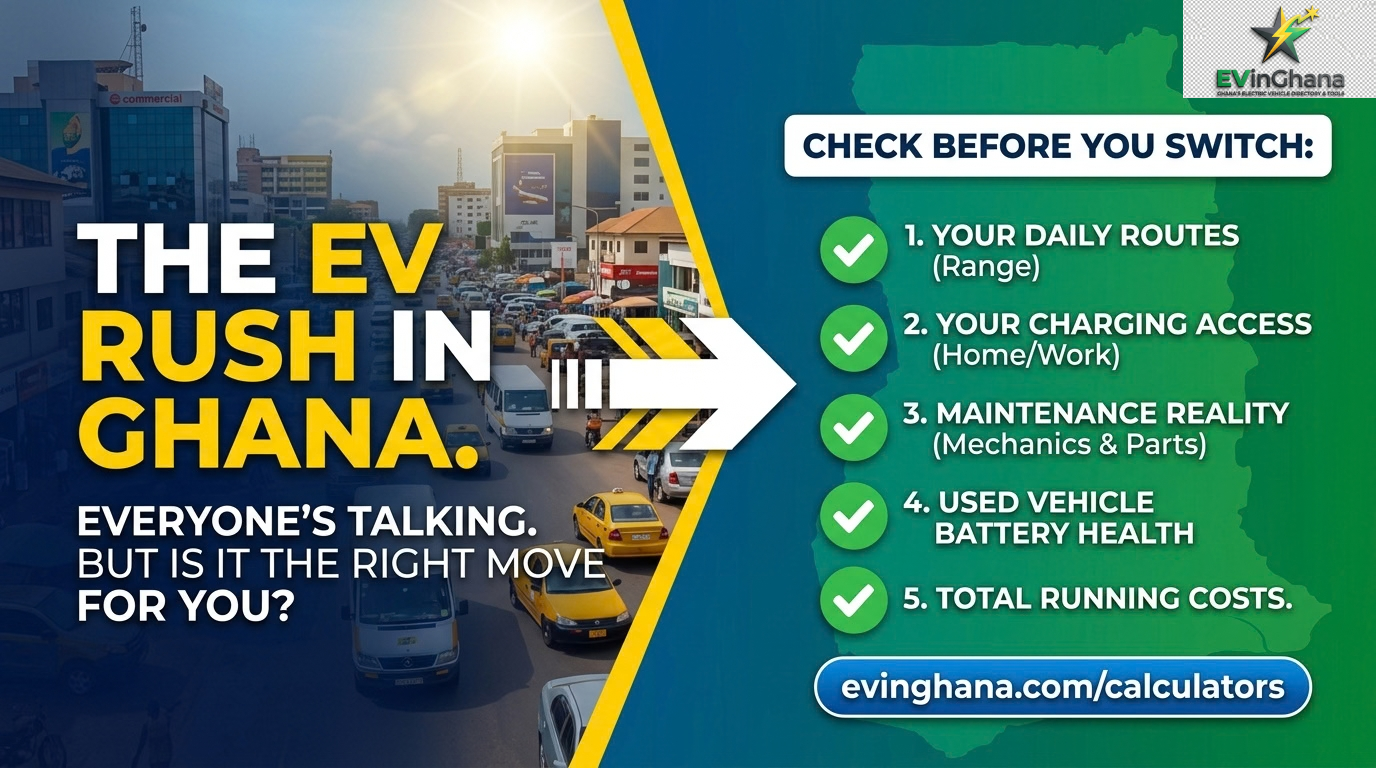
There is a rush around electric vehicles right now. More people are talking about EVs, more importers are offering them, and more drivers are wondering whether it is time to switch. In Ghana, that interest makes sense. Fuel prices can be painful, city driving is tiring, and the idea of lower running costs is attractive.
But an EV rush can also lead to rushed decisions. A car that looks affordable on paper may not fit your daily routes, your charging access, or your maintenance expectations. The right approach is not to buy quickly because EVs are trending. It is to check whether an EV matches your actual use in Ghana.
Why people are paying attention to EVs
For many buyers, the attraction is simple: electricity can be cheaper than petrol or diesel for daily driving, and EVs usually have fewer moving parts. That can mean less routine servicing, fewer oil changes, and a quieter drive. For drivers with home or workplace charging, the convenience can be strong.
There is also a broader energy story. Ghana’s power mix is not clean in the absolute sense, but it is still different from burning fuel directly in a car. An EV can make sense for some drivers even before the grid becomes fully renewable. Still, that does not mean every EV is automatically a good fit.
Where the rush can go wrong
The biggest mistake is assuming every EV works the same way as a petrol car. Range changes with speed, traffic, hills, load, air conditioning, and battery condition. A advertised range can look fine until you start using the car in real Ghanaian conditions.
Another issue is charging. Public fast-charging is still limited, especially outside Accra. That means many owners will rely on home charging, workplace charging, or a carefully planned daily routine. If you cannot charge reliably, an EV may become stressful instead of convenient.
Used EVs also need careful inspection. Battery health matters a lot. So does warranty status, charger compatibility, and the availability of a mechanic who understands the model. A low purchase price can be misleading if the car later needs expensive repairs or a battery replacement that was never budgeted for.
Questions to ask before you buy
- How far do I drive on a normal day, and how often do I do longer trips?
- Can I charge at home, at work, or both?
- If I take this route regularly, will the car still have enough range with passengers, traffic, and air conditioning on?
- Who will service the vehicle, and are parts realistically available?
- Is the battery in good condition, especially if the car is used?
These questions sound basic, but they matter more than glossy sales talk. An EV is not only a vehicle choice; it is also an energy and charging choice.
What kinds of drivers are most likely to benefit
In Ghana, EVs tend to make the most sense for people with predictable daily driving and a reliable place to charge. That might include private car owners with a home charger, ride-hailing drivers with a fixed operating pattern, or businesses with depot charging for fleets.
Drivers who regularly travel long distances on short notice may need more caution. So may people living in places where charging access is uncertain. For them, an EV can still work, but only after route planning and honest budgeting.
Use tools before you commit
Rather than guessing, use practical tools before buying. EVinGhana offers free calculators that can help you think through the decision:
- A Range & Journey calculator to check whether an EV can complete a Ghana trip on one charge.
- A Fleet savings / total-cost calculator to compare EV and petrol or diesel running costs in Ghana cedis.
- A Solar EV charging calculator to estimate what it takes to charge an EV with solar, using default 400W panels.
These tools will not make the decision for you, but they can reduce guesswork. They are especially useful if you are comparing several vehicles or trying to understand whether home charging or solar could work for your situation.
The practical conclusion
The EV rush is real, but speed is not the same as readiness. For Ghanaian buyers, the key is to separate excitement from fit. If you can charge reliably, understand your daily driving pattern, and verify the vehicle’s condition, an EV may be a smart move. If not, waiting and learning more may be the better decision.
In other words: do not buy an EV because everyone is talking about EVs. Buy one because it works for your routes, your budget, and your charging reality.
If you are considering an EV in Ghana, the best first step is not a showroom visit. It is a realistic check of range, charging, and total cost.
For more practical help, explore the EVinGhana directory of EV businesses and the free calculators at /calculators.