
Ghana’s EV charging market is entering a new phase
Electric vehicles are gradually becoming more visible in Ghana, especially in major cities. But as more drivers, fleet owners, and businesses look at EVs, one issue keeps coming up: charging. Public charging is still limited, and most EV owners currently rely on home, workplace, or private chargers.
That is why any move to regulate EV charging stations matters. Rules can help the sector grow in a more organised way, but they can also add costs and compliance steps for businesses. For Ghana, the key question is not simply whether to regulate, but how to do it without slowing useful investment.
Why regulation is being discussed
Charging stations are not just plugs on a wall. They draw meaningful power from the grid, often for long periods, and they need safe electrical design, proper installation, and reliable management. As the number of EVs grows, regulators have to think about several issues at once:
- Electrical safety for users, buildings, and equipment
- Grid impact from clustered charging demand
- Consumer protection, including clear pricing and honest service claims
- Standards for connectors, metering, and installation quality
- Planning for where stations should be built and how they should connect to supply
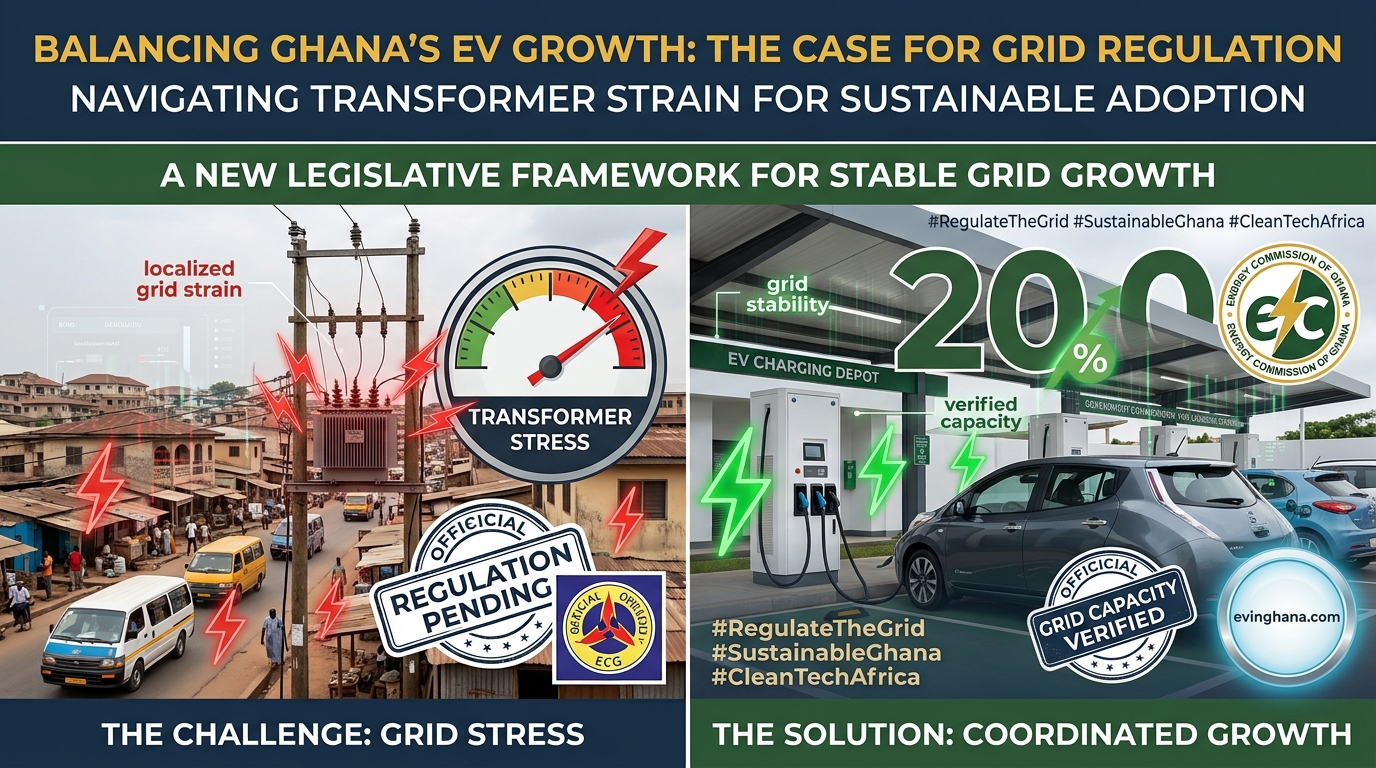
In a country like Ghana, these concerns are practical rather than theoretical. The grid is not equally strong everywhere, and many neighbourhoods already experience local supply constraints. A charger installed without proper load assessment can cause problems for a home, business, or even a whole distribution feeder.
What regulation could help achieve
Good regulation can give the market confidence. Investors are more likely to build charging stations when the rules are clear. Drivers are more likely to trust public chargers when they know the equipment has been installed and tested properly.
For example, a sensible framework could encourage:
- safe installation by qualified electricians
- clear approval processes for public charging sites
- accurate energy metering and transparent billing
- basic technical standards for charger equipment
- communication between charging operators and power distributors
This is especially important for faster chargers, which place a heavier and more immediate load on the grid than slower home chargers. If fast charging expands in the wrong places without planning, it can create avoidable stress on local supply.
What this means for EV owners
For drivers, regulation could eventually bring more confidence and better service quality. But it is worth being realistic: regulation alone will not suddenly create a dense charging network. Public fast-charging remains sparse outside Accra, and most EV journeys in Ghana still depend on careful route planning.
If you are considering an EV, ask practical questions before buying:
- Can I charge mostly at home or at work?
- Is my daily driving within the car’s realistic range?
- What happens if I need to travel outside my usual route?
- Are there reliable public chargers along the routes I use most?
These questions matter more than any headline about new charging rules. The right vehicle for one person may not be the right vehicle for another.
What this means for businesses and investors
For charging-station operators, the main message is to prepare early. Businesses that want to enter the market should expect more attention on permits, electrical design, metering, and site safety. It is better to build with compliance in mind than to retrofit later.
Businesses should also think beyond the charger itself. A good charging site needs stable power supply, accessible parking, clear signage, customer support, and a plan for maintenance. In Ghana, it may also make sense to consider solar support, battery storage, or smart load management where the economics work. Those options can reduce pressure on the grid, but they are not always cheap or simple.
The grid context in Ghana matters
Ghana’s electricity mix is cleaner than a coal-heavy system, but it is not a zero-carbon grid. That means EV charging can still offer climate benefits compared with petrol or diesel vehicles, but the full environmental picture depends on how the electricity is generated and how efficiently the charging system is run.
It also means planners should avoid treating EV charging as just another retail service. It is an energy service with implications for demand growth, network reliability, and long-term power planning.
In Ghana, the smartest EV charging policy is one that protects safety and reliability without making it unnecessarily hard to invest.
Practical next steps for readers
If you are a driver, fleet manager, or business exploring EVs or charging stations, start with evidence rather than assumptions. Check your route needs, compare the running cost of EVs versus petrol or diesel, and assess whether solar can support part of your charging demand.
EVinGhana provides free tools that can help with those questions:
- a Range & Journey calculator to check whether an EV can handle a Ghana trip on one charge
- a Fleet savings / total-cost calculator to compare operating costs in Ghana cedis
- a Solar EV charging calculator to estimate the solar setup needed for EV charging
You can also use the EVinGhana blog for more local explainers and the calculators page for the free tools. If you are looking for installers, mechanics, chargers, or other service providers, the EVinGhana directory is a useful place to start.
The bottom line is simple: regulation is not a barrier by itself, but it must be practical. Ghana needs EV charging rules that support safety, encourage investment, and keep the power system stable.