
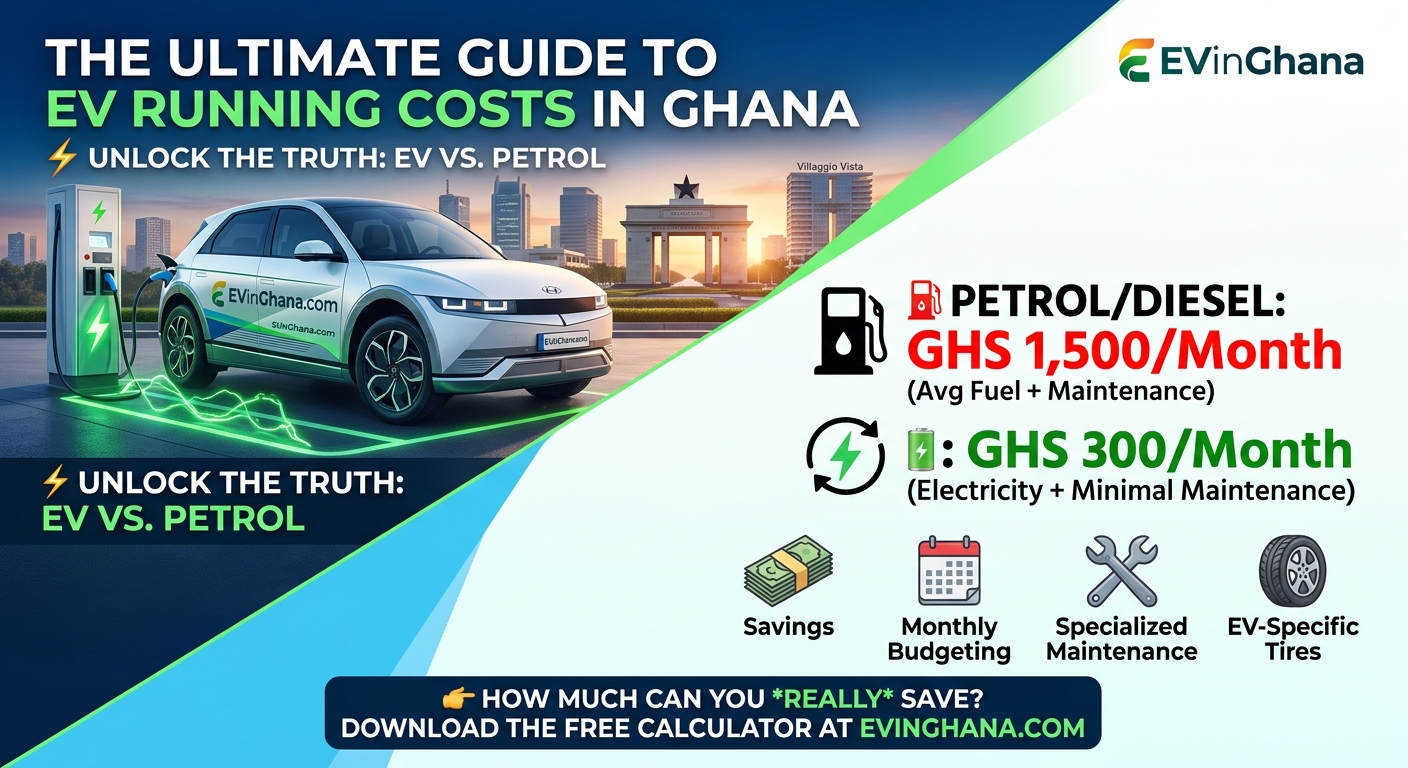
If you are comparing an electric vehicle with a petrol or diesel car in Ghana, the question is usually not just “Can I buy it?” but “What will it cost me to live with it every month?” That is the right question to ask.
The running cost of an EV can be lower than a fuel car, but the answer depends on where you charge, how far you drive, whether you can charge at home, and how much of your driving happens in city traffic versus long-distance travel. In Ghana, the local charging network is still developing, so the practical picture matters as much as the headline idea.
This guide breaks down the main cost components and shows how to estimate your own monthly budget before you buy.
The main running costs of EV ownership in Ghana
An EV does not need fuel, oil changes, or many of the routine engine services that a petrol car needs. But it still has real running costs. The main ones are electricity, maintenance, tyres, insurance, and sometimes charging equipment.
1) Electricity for charging
For most owners, electricity is the biggest day-to-day cost. The actual amount you pay depends on:
- how many kilometres you drive each month
- your vehicle’s battery size and efficiency
- your charging habits
- the tariff you pay at home or at a workplace charger
In simple terms, the more efficiently you drive and the more often you can charge at home, the easier it is to control cost. Charging from a standard home supply is usually simpler than relying on public charging, but your exact cost will depend on your electricity tariff and the vehicle’s consumption. Because tariffs can change, check the latest numbers before making a decision.
2) Home charging equipment
Some EV owners can use a regular socket for slow charging, while others prefer a dedicated wall charger for convenience and safer daily use. The right choice depends on your car, your home wiring, and how much you drive.
In Ghana, this is an important practical issue. Before installing anything, have a qualified electrician assess your home. If your wiring is old, undersized, or not properly earthed, charging can become inconvenient or unsafe. That extra setup cost is not always large, but it should be included in your budget.
3) Solar charging, where it makes sense
If you already have a solar system, charging an EV from solar can reduce reliance on the grid during daytime hours. That said, solar is not “free” once you account for the cost of panels, batteries, inverter capacity, and installation.
Solar can make sense for some households and businesses, especially if the vehicle is parked during daylight and has a predictable daily route. It is less straightforward if your driving is irregular or if your solar system is sized only for basic household use. The key is not whether solar sounds attractive, but whether your system can actually handle the load.
4) Maintenance
EVs generally have fewer moving parts than internal-combustion vehicles, so routine maintenance can be simpler. There is no oil to change, and some common engine-related jobs do not apply. But EVs still need regular care.
- Brake checks and brake fluid maintenance
- Tyre rotation and alignment
- Suspension and steering inspections
- Cabin air filters and cooling-system checks
- Battery and software-related diagnostics when needed
The cost and availability of EV-trained technicians matter in Ghana. If a problem comes up, you want someone who understands the vehicle, can source the right parts, and can diagnose it correctly. That is one reason to use a directory of known EV businesses rather than guessing. You can explore the EVinGhana directory and related resources at /blog and /calculators.
5) Tyres
Tyres deserve special attention. EVs can be heavier than similar petrol cars because of the battery, and the instant torque can put extra stress on tyres if you drive aggressively. That does not mean EV tyres are always expensive or short-lived, but tyre choice and driving style matter more than many first-time buyers expect.
For Ghanaian roads, especially where road surfaces vary, it is wise to budget for good-quality tyres and regular alignment checks. Underinflated or worn tyres can quickly erase any savings from efficient charging.
6) Insurance and other ownership costs
Insurance is an important part of total ownership, but the premium will depend on the insurer, vehicle value, and your coverage. For EVs, owners should also check how battery damage, charger equipment, and specialist repairs are treated in the policy. Do not assume standard wording covers everything you care about.
You may also face costs for licensing, registration, parking, security, and home electrical upgrades. These are not unique to EVs, but they belong in the full cost picture.
How driving pattern changes the numbers
Not every EV owner saves in the same way. Your usage pattern matters a lot.
Mostly city driving
If most of your driving is in Accra, Kumasi, Takoradi, or another urban area, an EV can be a practical fit. Stop-start traffic often suits EV efficiency, and daily routes are easier to plan. City drivers are also more likely to benefit from home charging because the car returns to the same place often.
Frequent intercity travel
If you travel long distances regularly, public fast charging becomes much more important. In Ghana, fast charging is still limited outside major urban centres, so route planning matters. If your trips depend on a charger being available at the right time and place, your experience may be less convenient than advertised.
That does not make EV ownership impossible for intercity drivers, but it does mean your cost estimate should include time, detours, and the possibility of charging uncertainty. Convenience has value too.
Commercial or fleet use
For taxis, ride-hailing, delivery, corporate fleets, and shuttle services, the monthly savings picture can be stronger because the vehicle is used more intensively. But the business case depends on daily mileage, charging access, maintenance discipline, and downtime. A vehicle that spends too much time waiting for a charger or a technician is not saving money.
A simple framework for comparing an EV with a petrol car
Instead of focusing only on the purchase price, compare the total monthly running cost. A useful framework is:
- Estimate your monthly kilometres.
- Estimate how much electricity the EV will need for that distance.
- Check the cost of home charging, workplace charging, or public charging where relevant.
- Add expected maintenance, tyres, insurance, and any charging equipment costs.
- Compare that total with your current fuel, oil, and servicing costs for a petrol or diesel vehicle.
If you want a more structured comparison, use EVinGhana’s fleet savings and total-cost tools at /calculators. They are especially useful if you want to compare multiple vehicles, estimate operating cost over time, or test different driving patterns.
Checklist before you buy
Before purchasing an EV in Ghana, ask yourself these questions:
- Can I charge reliably at home or work?
- How often do I drive long distances outside my city?
- What is the actual electricity tariff I will pay?
- Do I need a wall charger, electrical upgrade, or solar support?
- Are there local technicians who can service the model I want?
- What does the insurance policy say about battery and charger-related damage?
- How much will tyres and routine upkeep add each month?
If any of those answers are unclear, do not rush. The best EV decision is the one that fits your daily life, not the one that looks best on paper.
Bottom line
In Ghana, EV ownership can be financially attractive, but only when the whole system fits your needs. Electricity is usually a major part of the running cost, yet charging access, maintenance support, tyre wear, and driving pattern can change the result a lot. Public charging is improving, but it is still not evenly available across the country.
That is why a real cost comparison should start with your own numbers. Use the EVinGhana calculators, check the directory for charging and servicing options, and make a decision based on how you actually drive.
Good EV ownership is not about guessing savings. It is about matching the vehicle, the charging plan, and the driving pattern to your real life in Ghana.