
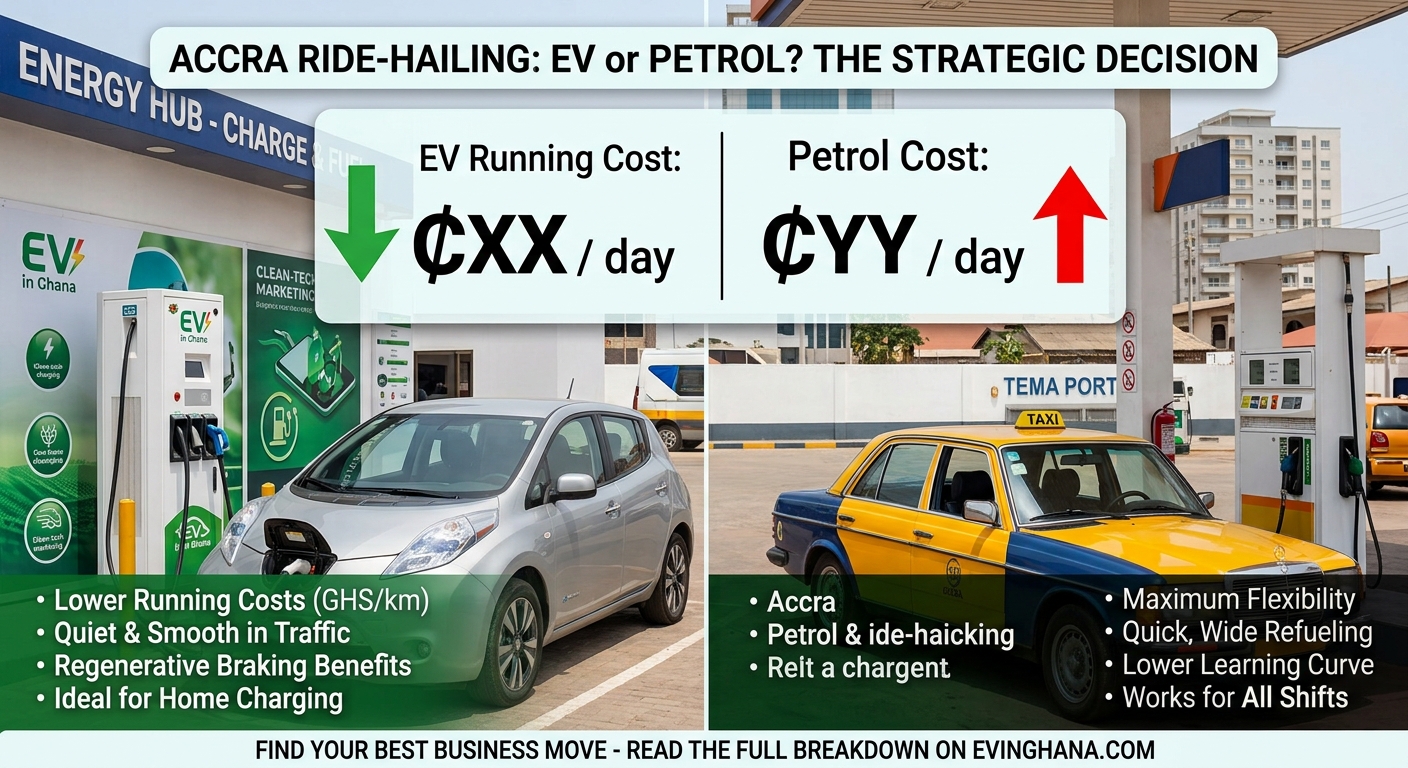
If you drive ride-hailing in Accra, the question is not just “EV or fuel?” It is really about operating cost, downtime, charging access, and how your car fits your daily work. The honest answer is that neither option is best for every driver.
An electric vehicle can make strong financial sense for a high-mileage driver who can charge at home, at work, or at a reliable charging point. A petrol car is still easier to keep moving if you do long shifts, live where charging is difficult, or need very quick refuelling between trips.
What matters most for ride-hailing drivers
When you earn from daily trips, the most important factors are:
- Running cost per kilometre — electricity is usually cheaper than petrol or diesel for the same distance.
- Time off the road — charging can take longer than filling a tank.
- Range confidence — you need enough battery for real Accra traffic, not just ideal lab numbers.
- Maintenance — EVs usually have fewer moving parts, but tyres, suspension, brakes, and battery care still matter.
- Charging access — if you cannot charge reliably, the EV advantage drops sharply.
Why an EV can be a good fit
For ride-hailing, an EV’s biggest advantage is lower energy cost. Stop-start traffic, frequent short trips, and lots of braking can actually suit an EV well. Regenerative braking can recover some energy in city driving, and the lack of engine oil changes and some other routine engine-related maintenance can reduce workshop visits.
If you drive many kilometres each day, that lower operating cost can add up over time. That is why some high-mileage drivers look at EVs as a business tool rather than a lifestyle choice.
EVs can also feel smoother in traffic. Instant torque helps with gaps in stop-and-go driving, and some drivers prefer the quieter cabin during long hours on the road.
Where EVs are still difficult in Accra
The main challenge is charging. Public fast-charging is still limited, and outside the most connected parts of Accra, finding dependable charging can be difficult. If your day depends on staying online continuously, that matters a lot.
Another issue is downtime. A fuel car can be refuelled in minutes. An EV may need a much longer stop unless you have access to fast charging, and even then you should plan around charging time. For a ride-hailing driver, every hour off the road is lost earning time.
You also need to think about your home situation. If you live in a place where overnight charging is not practical, ownership becomes much less convenient.
Why a fuel car is still the safer default
For many Accra drivers, a petrol car remains the simpler choice because the refuelling network is widespread and familiar. You can top up quickly almost anywhere, and that flexibility helps when demand is unpredictable.
Fuel cars also have an easier learning curve. Mechanics are widely available, most drivers understand how to maintain them, and there is less uncertainty about charging infrastructure. If your work depends on being available at all hours, that reliability can outweigh the fuel savings of an EV.
That does not mean fuel is cheaper in the long run. It means fuel is often less complicated today.
Best choice by driver type
An EV may be better if you:
- drive a lot every day
- can charge at home or at a dependable location
- work mostly within Accra or on predictable routes
- want lower running costs and can handle charging planning
A fuel car may be better if you:
- need maximum flexibility
- cannot charge reliably
- do long, irregular shifts
- want the simplest day-to-day operation
A practical way to decide
Before buying either vehicle, run your own numbers. Don’t rely on general claims. Use EVinGhana’s free calculators to compare your actual ride-hailing pattern:
- Fleet savings / total-cost calculator — compare EV and petrol or diesel running costs in Ghana cedis.
- Range & Journey calculator — check whether an EV can handle your usual Accra trips on one charge.
- Solar EV charging calculator — see what it takes to charge with solar, using the default 400W panel setup.
Also check the EVinGhana directory for local EV businesses, including dealerships, mechanics, solar installers, and charging stations. That can help you see what support actually exists before you commit.
Bottom line
If you are a ride-hailing driver in Accra and you can charge reliably, an EV can be the better business decision because of lower running costs. If you need easy refuelling, maximum flexibility, and minimal downtime, a fuel car is still the safer option today.
The best choice is not the most exciting one. It is the one that matches your routes, your charging access, and your daily earning pattern.