
Why home charging matters
For most EV owners in Ghana, home charging will be the main way to keep the battery topped up. Public charging is still limited, especially outside Accra, so being able to charge safely at home makes EV ownership much easier and more predictable.
The good news is that home charging is usually simple. The less good news is that it is not always as easy as plugging into any wall socket and walking away. The right setup depends on your home wiring, your daily driving, and how much power your supply can comfortably handle.
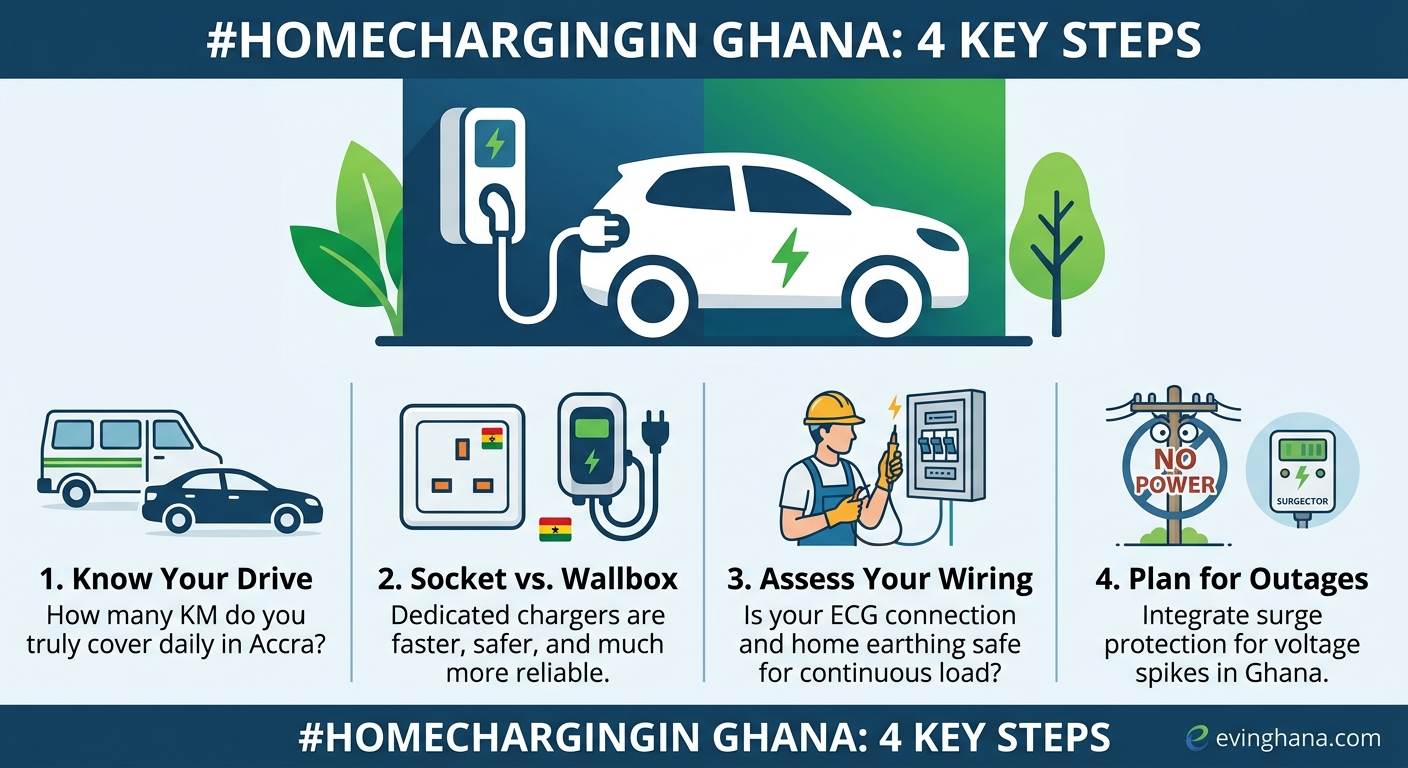
Start with your daily driving needs
Before buying any charging equipment, think about how far you usually drive in a day. Many drivers do not need to fully recharge every night. If your daily travel is modest, a slower overnight charge may be enough. If you drive long distances often, you may want faster home charging and a more careful electrical assessment.
If you are unsure whether an EV will fit your routine, EVinGhana’s free Range & Journey calculator can help you check whether a given trip is realistic on one charge. That is especially useful for trips between cities, where terrain, speed, traffic, and air-conditioning can all affect range.
Choose the right type of charging
There are two broad home-charging approaches:
- Standard socket charging: This uses a regular household outlet with the cable supplied by the vehicle or charger. It is the simplest option, but also the slowest. It may be suitable if you drive less each day and can charge overnight.
- Dedicated home charger: This is a proper wall-mounted charging unit installed by a qualified electrician. It is generally safer, more reliable, and faster than using an ordinary socket for long charging sessions.
In practice, many EV owners eventually prefer a dedicated charger because it puts less strain on household sockets and gives more predictable charging.
Check your home electrical setup first
Before installing anything, get a qualified electrician to inspect your wiring, distribution board, and earthing. This is important in Ghana, where many homes have varying levels of wiring quality and load capacity.
Ask the electrician to consider:
- whether the circuit can handle sustained charging
- the condition of the socket or feeder line
- earthing and basic protection devices
- space for a dedicated circuit and isolator
- how charging will affect the rest of the house when other appliances are running
If your home already runs items like air-conditioners, water heaters, pumps, or freezers, EV charging may need to be scheduled around those loads. Even if the charger itself is not very complicated, the total household demand can become the real issue.
Do not rely on an ordinary socket without caution
An EV can sometimes charge from a regular socket, but that does not automatically make it the best long-term solution. A socket that seems fine for lights, television, or phone chargers may not be ideal for many hours of continuous EV charging.
The safest approach is to treat ordinary socket charging as a temporary or occasional option unless an electrician confirms the circuit is suitable. Heat at the socket, loose plugs, or repeated tripping are warning signs that should not be ignored.
If a socket, plug, or cable gets warm during charging, stop and have the installation checked by a professional.
Think about power cuts and voltage instability
In Ghana, outages and voltage fluctuations can affect home charging. An EV is not usually damaged by a simple interruption, but frequent interruptions can make charging inconvenient and may be hard on some equipment if the installation is poor.
If your area has unstable supply, talk to the installer about surge protection and proper changeover arrangements. If you use a generator, do not assume it is suitable for EV charging without checking the generator’s output, stability, and the charger’s requirements.
Solar can help, but it is not automatic
Some homeowners want to use solar to reduce grid dependence or lower running costs. That can make sense, but it depends on roof space, battery size, charging habits, and how much daytime sun you can capture.
EVinGhana’s free Solar EV charging calculator can help you estimate how much solar you may need to charge an EV, using default 400W panels. It is a useful starting point, but any real installation should be sized by a qualified solar installer who understands both the EV load and your household needs.
Keep in mind that solar charging at home is usually easiest when the car is parked for long periods during the day, or when you have battery storage to shift energy into the evening. Without that, you may still rely heavily on the grid.
Make charging part of a simple routine
Home charging works best when it becomes a habit. Many EV owners plug in when the battery is low enough to justify charging, rather than trying to refill every night. That reduces unnecessary wear on the system and makes energy use easier to manage.
A practical routine might include:
- plugging in after returning home
- avoiding charging during peak household use if your wiring is limited
- checking cable condition regularly
- keeping the charging area dry and clear
- tracking how long your usual top-up takes
What to ask before you buy equipment
If you are shopping for a home charger or asking an electrician for help, useful questions include:
- Is this charger suitable for my vehicle?
- Can my home wiring support this load safely?
- Do I need a dedicated circuit?
- What protection devices should be installed?
- How will this work during outages or low voltage?
- What maintenance does the equipment need?
When to get professional help
Get professional help if your home wiring is old, if you are unsure about load capacity, if you want solar integration, or if you plan to charge a fleet vehicle at home. You should also speak to a professional if your socket trips, the cable overheats, or charging seems unusually slow.
EVinGhana’s directory can help you find Ghana-based EV businesses, including EV mechanics, solar installers, and charging-related services. That can save time when you want someone who understands both the vehicle and the local electrical context.
Bottom line
Home charging in Ghana is very doable, but it should be approached carefully. Start by understanding your driving needs, then make sure your home wiring can support regular charging safely. For many owners, a dedicated charger and a professional electrical check are worth the extra effort. If solar is part of your plan, use it as a properly sized system rather than a guess.
The most practical path is simple: assess your home, choose the right charger, install it safely, and build a routine that fits your electricity supply and daily driving.