
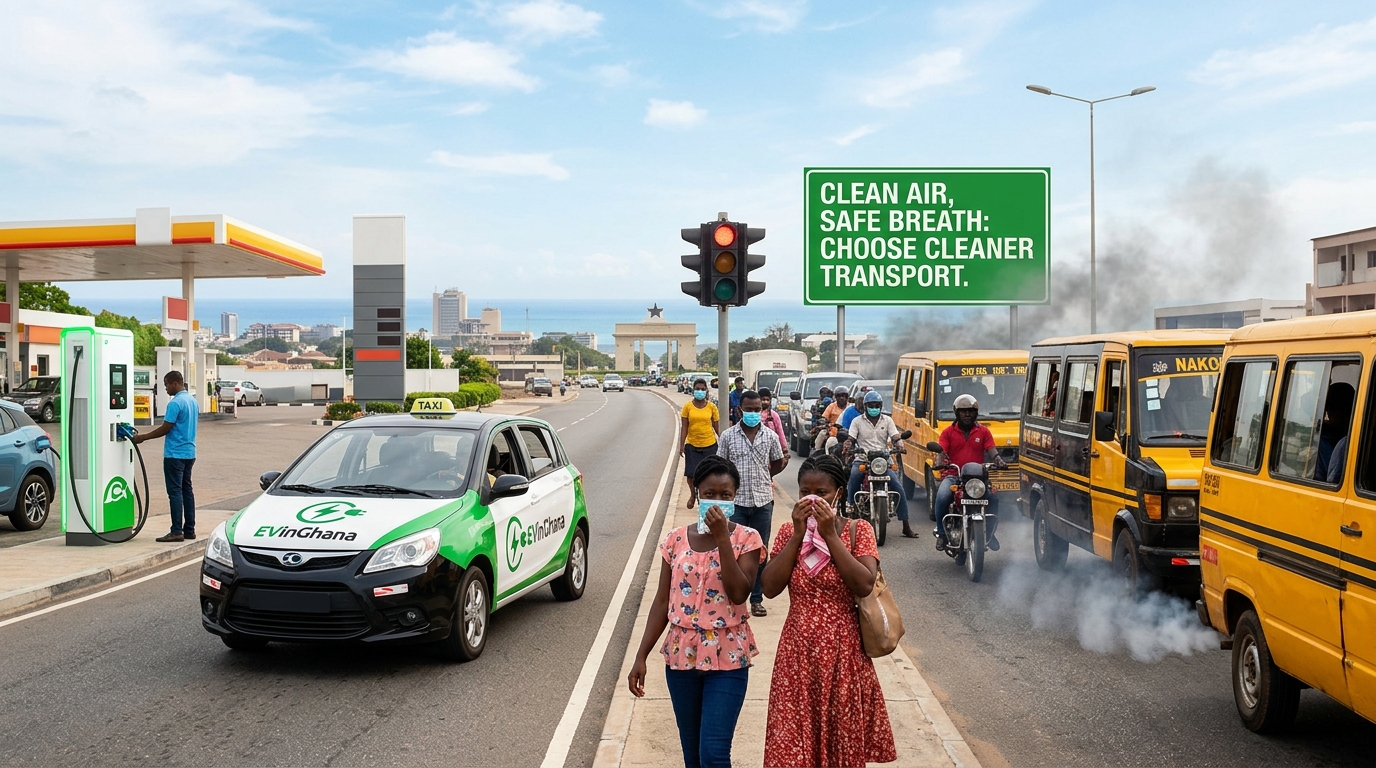
Air pollution is not just an environmental issue in Ghana. It is a public health problem that affects families, workplaces, schools, and hospitals every day. Public health stakeholders and global air quality reporting have warned that air pollution contributes to a large number of premature deaths in Ghana each year. The exact figure can change by source and year, but the message is clear: the burden is severe, and transport is part of the problem.
Vehicles are one of the visible sources of urban air pollution. Exhaust from petrol and diesel engines adds fine particles and gases to the air we breathe, especially in busy traffic corridors, around terminals, in commercial centres, and near areas with poor ventilation. When many vehicles are old, poorly maintained, or heavily used in stop-start traffic, the impact on air quality becomes worse.
This matters because air pollution does not stay outside. It gets into lungs and the bloodstream. Over time, it can contribute to breathing problems, heart disease, stroke, and other health conditions. Children, older adults, pregnant women, and people with existing health conditions are especially vulnerable.
Why transport is part of the solution
Ghana cannot solve air pollution by focusing on one sector alone, but cleaner transport is an important part of the answer. That does not mean electric vehicles are a magic fix. It means they can help reduce tailpipe emissions, especially in cities and along busy routes where exhaust is concentrated.
Electric vehicles have no exhaust pipe emissions while driving. That can improve local air quality, particularly where traffic is dense. They also tend to be quieter, which can reduce noise pollution in communities near busy roads. But their overall environmental benefit depends on how they are charged and how the electricity is generated. Ghana’s grid is cleaner than a coal-heavy grid, but it is not completely clean, so the climate and air-quality benefits vary.
It is also important to be honest about the current limitations in Ghana. Public fast-charging is still sparse outside Accra, and not every route or business use case is suitable for an EV today. A good transition requires planning, not wishful thinking.
What individuals and businesses can do now
Not everyone can buy an electric vehicle today, and that is okay. Reducing pollution starts with practical steps that many people can take:
- Maintain vehicles properly. Well-serviced engines pollute less than neglected ones.
- Avoid unnecessary idling. Sitting with the engine on adds emissions without moving anyone.
- Choose efficient trips. Combine errands and carpool where possible.
- Consider cleaner vehicles when replacing a car. If an EV fits your driving pattern, it may reduce local exhaust pollution.
- Support better fleet decisions. Taxi operators, delivery businesses, and institutions can use cleaner vehicles where routes and charging options make sense.
For businesses, the conversation should be about total cost and practicality, not just purchase price. EVinGhana offers a free fleet savings calculator that helps compare running costs in Ghanaian cedis. It also has a range and journey calculator to check whether an EV can complete a given Ghana trip on one charge, and a solar EV charging calculator for people considering charging with rooftop solar.
The role of cleaner energy
Cleaner transport works best when paired with cleaner electricity. If an EV is charged from solar, some of the emissions are shifted away from the tailpipe and away from fossil fuel use. That does not solve every problem, but it can make a meaningful difference, especially for homes, offices, depots, and commercial fleets that can charge during the day or on-site.
Solar does not need to be complicated to start. The key questions are simple: how much energy does the vehicle need, how often is it driven, and can charging be scheduled to match available solar production? Those are the kinds of practical questions the EVinGhana calculators are designed to help answer.
A public health issue, not only a transport issue
Air pollution is sometimes discussed as if it were only about cars, but it affects health, productivity, and household finances. People miss work. Children miss school. Families spend more on treatment. Hospitals carry more of the burden. Cleaner air should therefore be treated as a national development goal, not a niche environmental concern.
We are part of the problem, but we can also be part of the solution.
That solution will include better public transport, stricter vehicle maintenance, smarter city planning, cleaner industry, and cleaner fuels and vehicles over time. Electric vehicles are one tool among several. They are not the whole answer, but they can help reduce the pollution coming from transport when used in the right context.
If you are exploring cleaner transport in Ghana, start with facts and practical tools. Check whether an EV suits your route, compare running costs, and think about how charging will work in real life. The best decision is an informed one.